

Guest Post: Black Blades
A Response to “Gurthang and Sokka’s Black Sword” by Jacob Newkirk

Greetings Tolkien Poppers!
Spring is just around the corner, which means that Tolkien Reading Day is not far behind! For those who are not familiar with this Tolkienist holiday, it is held on March 25th of each year because it marks the anniversary of the destruction of the One Ring in The Lord of the Rings. Each year, The Tolkien Society puts forth a new theme and fans are encouraged to read their favorite Tolkien writings that pertain to the theme as a way to celebrate and promote Tolkien’s life and works. You can see what is planned for this year here: https://www.tolkiensociety.org/events/tolkien-reading-day-2026/
However, I’m not here to promote Tolkien Reading Day, but to post a response to one of my essays from my friend Jacob! As a writer, it’s not everyday that someone takes the time to read one’s work carefully and even less frequent to inspire someone to respond to it! Jacob has done both and I love every bit of what he’s written.
In my essay, “Gurthang and Sokka’s Black Sword: Avatar: the Last Airbender’s Redemption of the Dark Blade in Myth and Fantasy,” I discuss the tradition of Black Swords in myth and fantasy and how Avatar: The Last Airbender subverts that tradition to do something good with the trope by comparing it to Gurthang in The Children of Húrin. You can read it here:
Jacob expands upon, adds, and subtly critiques some of my logic and interpretations in the essay. Ultimately, his response highlights the Black Sword as a symbol for the consequences of choosing power over fellowship. It’s a fantastic piece and I hope that you will enjoy this guest post from Jacob!
The history of fated or cursed weaponry feels as old as story itself. Tyrfing emerged from a culture that inspired the Legend of Excalibur, on to the modern example of the Elder Wand. These curses, on the surface, are only curses in the context of the wielder. Tyrfing demands a death each time it is drawn; is that not the function of a sword? But this starkness, this push to examine the consequence before the action seems to be the real curse.
Much could be written about the curses experienced by Túrin Turambar - but the nature of these curses I’ve mentioned lead me to do the same with him. The consequences of Túrin’s experiences, are they because of a curse? Or are they consequences we should expect of a man who with every choice walked the path of vengeance and destruction? Was Túrin cursed by Morgoth to torture Húrin, or did Túrin walk the road of Morgoth and reap the same reward? Of course, Turin did great good - but through him, didn’t Morgoth work the same kind of evil for which Gandalf refused the Ring?
The One Ring, itself probably the most famous cursed item in fiction, serves to teach the same lesson: our actions have consequences. Boromir looks upon the Ring and sees a tool, a way to defend his people. But if we look at the consequence first, we see the evil Sauron would bring about: a Gondor constantly at War. A Gondor who refuses faith and friendship, and like Túrin Turambar, is sworn to the sword. This is not a failing of Boromir, it is simply an exposure of his desperation and semi-hidden hopelessness. To me, Boromir’s failure is not when he attempts to seize the Ring, but when in Lothlórien the Lady Galadriel invites him into hope and he rejects the call. He forecloses on Gondor’s future, cementing his eventual attempt to take the Ring.
Contrast this with Aragorn and Faramir. Both Men are presented with the same opportunity as Boromir, but neither has so foreclosed on hope that they cannot do what the curse asks them to do: look at the consequences first. For Aragorn, this is his opportunity to ascend to that which he has always doubted in himself; to rise as high as his Númenórean forebears, to truly be Isildur’s Heir. Instead, he shows the wisdom to be gained from those same forebears’ victories and defeats: to trust outside his heritage, in other Men and allies.
Faramir’s trial is much more personal in nature. He learns from Frodo simultaneously of his brother’s death and lowest moment, and is then presented with the same challenge his brother failed. But, whether from Gandalf’s tutelage or his Númenórean heritage that ran stronger in him than his brother, or perhaps even due to less exposure to the influence of the Ring’s corruption, Faramir grasps the importance of Frodo and Sam’s mission. He holds to the fool’s hope, but still a hope. And he releases Frodo to his fate.
Frodo himself is an interesting test case for this curse theory. How important is it that Frodo bears the Ring, and least initially, unwillingly? He is no Túrin, claiming and renaming the Ring for his own purpose. Instead he does what he must for the land he loves. He inspires love and devotion for his bravery, but even Frodo at the end is corrupted by the Ring’s influence. Yet, it is still Frodo’s, and only Frodo’s, actions that bring about the Ring’s destruction. Frodo’s choice to trust and spare Gollum, against Sam’s wishes, is ultimately what brings about the destruction of the Ring. So here, by examining the consequences not of bearing the Ring, but by how he treats an enemy, Frodo is able to save all Middle-earth.
This quality is clearly presented throughout fiction as the mark of a hero. Luke choosing to trust his father, in spite of all the evil Darth Vader has wrought; Harry embracing his fate to give his friends an opportunity to defeat Voldemort for good; Aang refusing to kill and committing himself to finding another solution to his inevitable confrontation with Ozai. Aang in particular showcases this quality so clearly, from his minor actions to his major choices. The same property even gives us an example of the opposite in Zuko, who continually refuses to look at the consequences of his actions until his beloved Uncle Iroh is imprisoned. All of these examples, what are they trying to teach us?
I would argue the lesson is this: that often our intentions mean little when weighed against the consequences of our actions. An evil act done to try and right a wrong is still an evil act. So we must always ask ourselves an important question. Will this course grow the case for peace, or diminish it? Will this cure strife for all, some, most, or just me?
Put simply, What are the consequences?
Thanks for supporting Tolkien Pop! My writing would not be what it is without your readership. If you’d like to continue to support Tolkien Pop!, you can get a Tolkien Pop! shirt and/or a sticker: https://byte-geist-shop.fourthwall.com/products/tolkien-pop

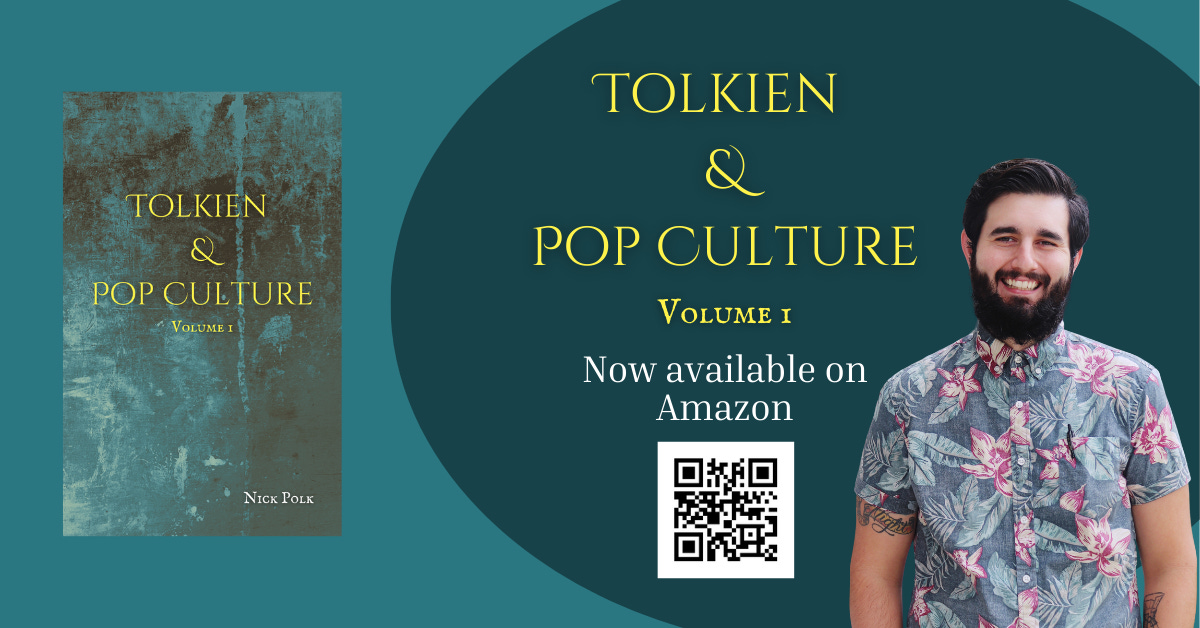
My book Tolkien and Pop Culture: Volume I is now available! This book is a selection of my Substack posts from the past couple of years, cleaned up, and formatted for publication. For the first time, you can get all these essays in print or in your Kindle library. It’ll look great on your shelf and be available for your own Tolkien purposes! Use the QR code, the link, or direct message me to order your copy: https://a.co/d/eBE7jiH
Intriguing enough that I bought your book (Kindle version).